Annual Report 2025
Samira’s journey to independence.

Nineteen-year-old Samira has glaucoma, an eye condition that damages the optic nerve. When she came to Australia as a refugee from her home country of Afghanistan, with only the English she learned from watching YouTube, she wasn’t expecting to be met with immediate support.
After a week of living in Australia, Samira was put in touch with Guide Dogs NSW/ACT and, shortly after that, she received her first Orientation and Mobility session. “Before that time, I had never held a cane,” said Samira. “When I held a cane, it was a strange feeling. I don’t know how to explain it. I couldn’t hold back my tears.”
For Samira, holding a cane in her hand for the first time was confronting because it made her feel helpless about having to accept her current situation. However, she didn’t give up.
With just a few months of Orientation and Mobility training, Samira could go grocery shopping and attend her English classes at TAFE by herself. She now lives on her own and is becoming more independent with each session. “Using a cane doesn’t mean I’m giving up my dream of being able to see. It motivates me to work harder than before,” says Samira.
Samira adopted the same persevering attitude towards her Assistive Technology training sessions. She’s learning how to use the voiceover and talkback features on her phone and recently started using a screen reader on her laptop. “If I practice, it will become easy and after a while, I’ll get used to it.”
Samira’s already come so far in learning how to navigate her environment independently with her cane and use Assistive Technology, and she’s determined to achieve her goals of studying and pursuing a career she loves.
The power of assistive technology.

Stephen lives with autoimmune retinopathy, a condition that gradually led to complete vision loss. With support from Guide Dogs NSW/ACT, Stephen has embraced assistive technology including a Miniguide and smart glasses to empower him to navigate his environment safely and independently.
When Stephen started experiencing changes in his vision, he faced significant challenges. The thought of becoming disorientated made him fearful of leaving the house, and he had to rely heavily on others for guidance. He became frustrated with technology and felt his independence slipping away. “My eyesight started disappearing 12 years ago and Guide Dogs helped me sort out my travel passes, Opal card and disabled parking pass. You’re lost when it first happens and it’s the little things you forget about, so I was glad to have the help,” says Stephen.
Through Guide Dogs NSW/ACT Orientation and Mobility Services, Stephen began walking regularly to the beachfront, something he used to always enjoy. He gained confidence using a long cane and learned orientation and mobility skills that he was able to transfer to different environments to support him to get around with greater ease. “I think the biggest change has been getting my independence back,” he says. “If I can feel it, I can do it. It just takes me a bit longer.”
By embracing assistive technology, Stephen has reconnected with recreational activities that give him a sense of purpose and routine. Before reaching out to Guide Dogs, he had lost access to visual hobbies like surfing, reading, and watching TV. By using assistive technology, including smart glasses, Stephen has rediscovered his love of reading through audiobooks and uses voice commands to interact with his devices. “It takes you away,” he says. “I can’t watch TV, so I just go and listen to my book.”
With the combined support of Orientation and Mobility and Assistive Technology Services, Stephen has regained his independence, reconnected with the activities that matter most to him, and feels more socially connected. “I’d recommend Guide Dogs to anybody,” he says. “I feel like I’ve been spoiled.”
Navigating from A to Z.

Seventeen months into their partnership, Abbie and her Guide Dog, Zita, share a bond that is stronger than ever. “I knew pretty much straight away that she would be my Guide Dog,” Abbie recalls. “Within the first five minutes of meeting her, we had an instant bond moment and clicked really well from there.”
Before working with Zita, Abbie relied heavily on others to navigate her community, often feeling like a burden. Transitioning from using a long cane to partnering with a Guide Dog brought new challenges, especially when a physical injury interrupted their early training. With support from Guide Dogs NSW/ACT, Abbie gradually built confidence through Guide Dog Mobility Training, learning new travel routes and deepening her trust in Zita’s guidance.
Today, Abbie navigates complex environments like her local shopping centre with freedom. “Zita gives me more independence and the ability to access my environment. It’s liberating,” she says. “She also makes me feel less anxious when I’m coming home as it starts to get dark. I don’t have any night vision, so I feel safer walking with Zita.”
This newfound autonomy has positively impacted Abbie’s relationships with family and friends. No longer needing to rely on others in busy or enclosed spaces, she feels more socially connected. “We can go out to lunch and just be there as myself and Zita, part of the family,” she shares.
Abbie’s confidence has grown so much that she’s now advocating for safer infrastructure in her local area, including contacting her council about the lack of a footpath near her home. “I deserve to have a footpath that I can walk on without it being slippery and dangerous,” she says.
With Zita by her side, Abbie has not only gained greater independence but also become a passionate advocate for accessibility. “Choice is everything”.
Nurturing the next generation.

Caring for a Breeding Dog is a unique and rewarding experience, and not just because of the puppy cuddles. For volunteer Home Whelper Emma, the deep bond she’s formed with Breeding Dog Charm, and the connection to the Guide Dogs community, have been truly special.
Through our Home Whelping and Puppy Rearing Program, volunteers like Emma provide loving homes for specially selected Breeding Dogs as they bring the next generation of Guide Dogs into the world.
When Charm joined Emma’s family, she was pregnant with her first litter. After helping deliver eight healthy puppies, Emma and her family felt an even stronger connection to Charm. Their bond only deepened with each new litter.
In her most recent whelp, Charm delivered just one puppy, Jilly. The experience was quieter but deeply meaningful, allowing Emma’s family to form a close connection with both mother and pup.
While the sleepless nights can be challenging, Emma says it’s all worth it. “Seeing a Guide Dog Handler in public and knowing I’ve played a part in giving that person a freedom that they wouldn’t have otherwise experienced is a great feeling.”
Our Breeding Dogs whelp according to their natural cycles, so litter timing and sizes vary. Whether it’s a litter of one or ten, every pup has the potential to change someone’s life.
Honouring a lifetime of loyalty.

Guide Dogs dedicate their lives to helping Handlers navigate the world safely and independently. When it’s time for them to retire, they deserve to do so in comfort, surrounded by the people who love them most.
Elaine, a long-time Guide Dogs Client, has partnered with three Guide Dogs throughout her life and has retired two of them. Her first Guide Dog, Evelyn, transformed her life. “For the first time since I lost my sight, I could walk upright and at a speed I wanted to walk at,” Elaine recalls. From that moment on, she says she never felt alone.
The bond between Elaine and Evelyn was built on trust, freedom, and companionship. When Evelyn retired, Elaine was devastated to lose her as a working companion, but delighted to keep her at home where she could enjoy her well-earned rest.
“After all they’ve done for you, you have this very special bond with them. You want them to be able to spend their retirement with you in a familiar environment, surrounded by loved ones,” she says.
Most Guide Dogs retire between the ages of eight and ten, though each dog is different. Retirement is influenced by factors such as age, health and temperament. Just as they choose their own career paths, many Guide Dogs often signal when it’s time to hang up their harness.
Many Handlers choose to keep their retired Guide Dogs as pets, a decision that benefits both the Handler and the dog. “From the dog’s perspective, they stay with someone who loves them. They don’t have to adjust to a new family or unfamiliar surroundings,” Elaine explains.
To support this transition, Guide Dogs NSW/ACT offers a Retired Guide Dogs Financial Support Program, which helps Handlers to manage age-related expenses such as veterinary care and food. All Guide Dog Handlers are eligible to apply.
Thanks to this program, Handlers like Elaine can continue caring for their loyal companions, ensuring that every Guide Dog is supported not only during their working life, but also through a well-deserved retirement.
Leadership in action.

Earlier this year, Guide Dogs NSW/ACT welcomed Belinda O’Connor as a Co-CEO intern through the Disability Leadership Institute (DLI) CEO and Executive Internship Program. This unique initiative offers senior leaders with disability the opportunity to share the helm of an organisation, gaining firsthand experience in executive leadership.
Belinda joined us with a clear purpose to advance her leadership journey and contribute to reshaping the disability leadership landscape in Australia. “Leading in a world not built for people with low vision or blindness is something disabled people do inherently,” she shared. “It’s crucial to see people like us in senior leadership roles, where our lived experience and professional expertise are recognised.”
During her two-month internship, Belinda conducted a strategic review of federal changes to Aged Care and assessed the implications of the new Support at Home packages for Guide Dogs NSW/ACT’s service funding. She also actively participated in leadership meetings and engaged in weekly mentoring sessions with CEO Dale Cleaver, gaining deeper insight into our strategy and operations.
Belinda was struck by our organisation’s genuine commitment to inclusion, not as a standalone initiative, but as a core part of how we do business. From the seamless setup of her screen reader on day one to the ability to access all work systems via her mobile phone, she experienced firsthand how accessibility is embedded in our workplace culture. “Being able to do my job in the palm of my hand has never been an option in previous roles, not because the technology wasn’t available, but because accessibility wasn’t prioritised.”
She also praised our desk-sharing and remote work arrangements, which support not only people with low vision or blindness, but all employees. “I’ve worked in environments where assistive technology needs weren’t considered, creating a ‘disability tax’. Guide Dogs NSW/ACT does it differently.”
Reflecting on her time with us, Belinda highlighted a common misconception: “Guide Dogs NSW/ACT isn’t just about Guide Dogs. The organisation supports people across the spectrum of vision loss, from mild to total blindness, helping them build skills, confidence, and independence. If you or a loved one is struggling with changes in vision, I encourage you to reach out.”
Belinda expressed her heartfelt thanks to Dale, Kate, the Executive Leadership Team, and the wider Guide Dogs community for their support and generosity. “It’s been a truly incredible experience.”
Connecting culture with digital accessibility.

Guide Dogs NSW/ACT is committed to ensuring culturally safe and inclusive access to our services for Aboriginal and Torres Strait Islander peoples, particularly those living with disability. Through our Reflect RAP, we are deepening our understanding of intersectionality and improving how we deliver support that respects both cultural identity and individual needs.
As part of this commitment, we partnered with Mirri Mirri, a leading provider of cultural education, to co-develop ‘Ngiyani: Working Together’, an online learning module for staff and volunteers. The module explores the intersectionality of Aboriginal and Torres Strait Islander peoples with a disability and inclusive employment practices.
Accessibility was a key focus throughout development. Initially, we aimed to incorporate features such as audio description, alt text, image descriptions, and screen reader-friendly navigation. However, the collaboration evolved into a broader learning opportunity. By sharing our expertise in digital accessibility, we supported Mirri Mirri to embed these features not only in our module but across their future offerings, to ensure other organisations can benefit from accessible and inclusive content.
“Accessibility was central to the module’s design. It reflects the importance of inclusive employment and the unique challenges faced by Aboriginal and Torres Strait Islander peoples with disability,” said Jaci Armstrong, Disability Inclusion Advisor.
We recognise that the impact of disability is often compounded for Aboriginal and Torres Strait Islander peoples, particularly in accessing healthcare and securing long-term, meaningful employment. Through ongoing learning, staff development, and culturally responsive service delivery, we are working to address these inequities.
While we’ve made meaningful progress, we acknowledge there is more to learn and do. Our journey continues with the Innovate RAP, as we strive to build a more inclusive and culturally safe future for our Clients, employees, volunteers, and communities.
Providing comfort and compassion in the courtroom.
.jpg?w=420&h=560&auto=format&q=90)
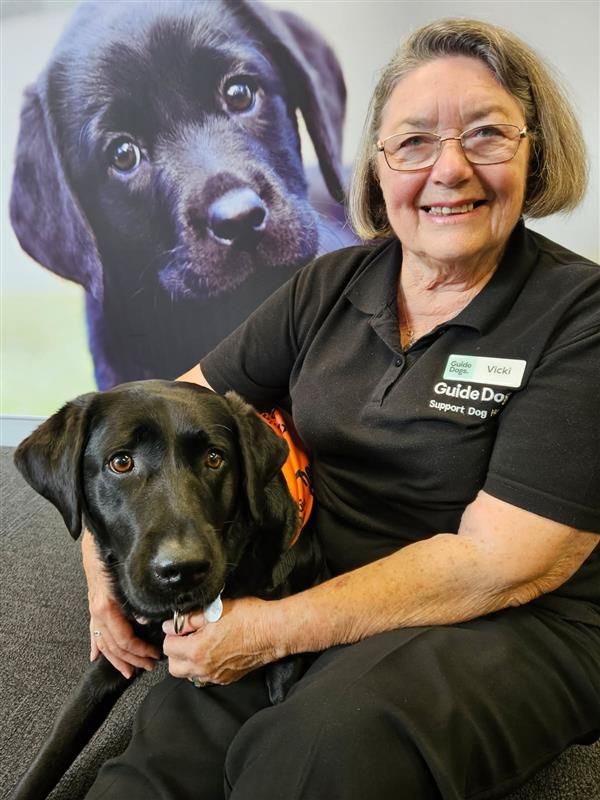
For more than 26 years, Vicki has been a dedicated volunteer with Guide Dogs NSW/ACT. Her journey began with a simple act of kindness; stepping in as a Temporary Carer for a Guide Dog while its Handler was in hospital. At the time, Vicki’s family had just lost their beloved Labrador of 15 years, and caring for a dog again brought comfort and healing.
From that moment on, Vicki welcomed dogs and puppies into her home for anywhere from a few days to seven months. Her deep love for animals and generous spirit kept her coming back, always ready to help in any way she could.
When the ACT Court Canine Support Program launched, Vicki didn’t hesitate to get involved. The program is a partnership between Guide Dogs NSW/ACT and the ACT Courts and Tribunal which provides emotional support to victims of crime and helps ease the stress of attending court.
Vicki and specially selected Therapy Dogs work in the Children’s Court and Remote Witness Unit, offering comfort during some of life’s most difficult moments. They also visit other areas of the courthouse, extending support to court staff.
One moment that stands out for Vicki was when a woman approached her and Therapy Dog, Quota. “She told me she’d been terrified of dogs her whole life,” Vicki recalls. “But after watching Quota and seeing how gentle he was, she felt safe enough to pat him. It warmed my heart.”
Volunteering has not only allowed Vicki to give back; it’s also taught her patience and understanding. “I’ve developed more compassion for people going through hardship and I’ve learnt how to connect with people experiencing family violence. It doesn’t cost anything to show kindness, and a smile can make a huge difference.”
Vicki’s commitment to the program has even extended to her own family. She now shares her home with Therapy Dog Sundae, a gentle and playful companion who eagerly joins her at court. “Sundae gets excited when she sees me putting on the uniform. She’s especially loving and gentle with puppies in our temporary care. She’s changed our lives significantly.”
More than two decades after her first “temporary” six-week commitment, Vicki continues to witness the healing power of the human-animal bond. What began as a chance opportunity has grown into a lifelong passion, one that brings comfort, connection, and hope to those who need it most.
Empowering our future advocates.

Barriers faced by people with low vision or blindness remain widespread in our communities. At Guide Dogs NSW/ACT, we’re committed to challenging these through advocacy and education, starting with the next generation.
Karlee, one of our Lived Experience Presenters, is part of a team of individuals with low vision or blindness who speak at schools, daycare centres, and after-school groups. Together, they’ve reached over 3,500 students aged six to eighteen, sharing personal stories and insights into navigating the world with low vision or blindness.
Presenters explain the difference between blindness and low vision, discuss societal barriers, and teach Guide Dog access rights and etiquette. Their impact is immediate and powerful. After just one session, a student felt confident enough to bring their cane to school for the first time.
Orientation and Mobility Specialist Kylie shared, “The kids were super engaged the whole time. You could see how deeply they were thinking by the questions they asked,” she said.
Karlee also introduces students to more complex ideas like the social model of disability and the importance of equity. “One of the misconceptions or stereotypes that I find day to day is people think I’m incapable of doing daily tasks. It’s the barriers in society with a lack of accessibility that makes things challenging for us, rather than the disability,” Karlee says.
Today’s students are tomorrow’s changemakers, so by sharing lived experience, our presenters are helping students to create a more inclusive future where everyone can participate equally.
The art of giving.

Who doesn’t love getting together with their friends and neighbours and having fun at community events? It’s even sweeter when you’re raising money for a great cause.
That’s exactly what our community groups do most weekends, like the Mudgee Support Group, who have been raising money for Guide Dogs NSW/ACT for over 40 years.
Their standout contribution is the annual Sculptures in the Garden exhibition, now one of rural NSW’s largest outdoor art events. Since the inaugural exhibition in 2010, the Mudgee Support Group has been a beloved fixture, bringing together Labradors and local art in a uniquely Mudgee way. Around 30 passionate volunteers help make the event a success each year, managing entry on the weekends and engaging with visitors to raise awareness and funds for Guide Dogs NSW/ACT.
A highlight for many attendees is meeting our adorable Labrador pups, who never fail to delight and inspire.
Now one of the largest outdoor sculpture exhibitions in rural NSW, Sculptures in the Garden is more than just an art show; it’s a celebration of community spirit and a commitment to making a difference. Funds raised through the event have supported our facilities at the Guide Dogs Centre at Glossodia, including play equipment for our pups, which is beneficial to their learning and development.
Events like this are only possible thanks to the tireless efforts of our long-term volunteers who generously give their time, energy, and expertise to support people with low vision or blindness.
"Volunteer support groups are the heart and soul of our mission. Their tireless efforts to engage their local communities, raise vital funds, and build awareness of Guide Dogs NSW/ACT help us empower people with low vision or blindness to live independently”, says Sally Biles, General Manager - Planned Giving.
By championing our cause in their own networks, our volunteer support groups not only contribute to our fundraising income but also strengthen our presence and impact across NSW and the ACT.
“We are deeply grateful for their passion, commitment, and the incredible difference they make every single day. Their support is not only valued, it’s truly appreciated," says Sally.
We extend our heartfelt thanks to all our community groups across NSW, especially our supporters in the Central Coast, Dubbo, and of course, Mudgee regions. Your dedication helps us continue our vital work and empowers our Clients to live the life they choose.