.jpg?rect=0,446,6296,4324&fp-x=0.5&fp-y=0.4772499946483445&w=3200&h=1800&fit=crop&crop=focalpoint&auto=format&q=90)
Building confidence and resilience
Building confidence and resilience is one of the most important parts of puppy raising. A future Guide Dog needs to be able to explore new environments, recover from surprises, and keep learning without becoming overwhelmed. Confidence does not mean the puppy must be bold in every situation. It means they feel safe enough to investigate, try, and engage. Resilience involves their ability to recover when something feels unexpected or difficult.
What confidence and resilience look like.
Confidence means the puppy is willing to explore, investigate, and engage with the world around them while staying relaxed enough to think and learn.
Resilience means the puppy can recover from small worries, surprises, or setbacks and return to a calm, functional state.
A confident and resilient puppy may show some of the following:
- Curiosity: willingly exploring new places, surfaces, objects, and experiences.
- Recovery: startling briefly, then returning to normal more easily.
- Adaptability: coping with changes in routine, environment, or people without becoming stuck.
- Calm engagement: staying relaxed enough to take food, respond to cues, or check in with the handler.
- Persistence: trying again when something is slightly challenging.
- Comfort around others: interacting appropriately with people and dogs without becoming overwhelmed.
- Playfulness and enthusiasm: enjoying training, play, and everyday activities.
Why confidence and resilience matter.
- They help the puppy cope with novelty: a Guide Dog puppy will experience many different environments, people, sounds, and surfaces.
- They support learning: puppies learn best when they feel safe and can stay in a calm, thinking state.
- They reduce the risk of fear-based responses: careful, positive exposure can help prevent lasting worry around everyday experiences.
- They improve long-term welfare: a puppy who can recover well and move through the world with confidence is likely to have a better quality of life.
How to build confidence and resilience.
Building confidence and resilience in your puppy can be achieved through observing the puppy, being aware of their body language, rewarding small efforts towards goal behaviours and providing opportunities for the pup to explore and learn in a safe, supportive environment. Other strategies for building confidence and resilience include:
- Observe body language and respond early: watch for signs the puppy is comfortable, unsure, or overwhelmed. If the puppy looks worried, create distance, lower the difficulty of the skill or activity, or pause.
- Use gradual exposure: introduce new people, places, surfaces, sounds, and activities in small, manageable steps.
- Reward investigation and recovery: reinforce the puppy for looking, approaching, exploring, checking in, and returning to calm after a surprise.
- Allow choice where possible: let the puppy observe, approach, or move away rather than forcing interaction.
- Keep experiences short and successful: end while the puppy is still coping and learning well.
- Support recovery: after busy or challenging experiences, give the puppy time for rest, quiet, sniffing, chewing, or decompression.
- Be patient and consistent: confidence grows over time through repetition and positive outcomes, not through pressure.
What this means in practice: if the puppy startles at a noise, hesitates near a new surface, or becomes unsure in a busy place, the goal is not to push through. Instead, give them space, keep your own body language calm, reinforce any small recovery or investigation, and only progress when they are back in a comfortable learning state.
In many ways, developing a confident and resilient pup is the core goal of puppy raising. These qualities help puppies cope with the normal challenges of everyday life and prepare them for the more complex learning they will do later. The following sections explore some of the experiences and activities that can help your puppy grow into a capable, adaptable adult dog.
Effective Socialisation.
Socialisation is about helping your puppy learn that the world is safe, predictable, and manageable. For a future Guide Dog, this means building confidence around different people, places, sounds, surfaces, objects, and everyday situations. Good socialisation is not about exposing the puppy to as much as possible, as quickly as possible. It is about creating positive, well-supported experiences that the puppy can cope with and recover from.
Why socialisation matters.
- Builds confidence: puppies who have positive, well-managed experiences are more likely to feel safe exploring new environments.
- Supports future Guide Dog work: Guide Dog puppies need to cope with a wide range of settings, sounds, people, transport, and movement in everyday life.
- Reduces the risk of fear and overwhelm: gradual, positive exposure helps prevent lasting worry around common experiences.
- Improves recovery: socialisation is not just about first exposure, it’s also about helping the puppy return to a calm, thinking state afterwards.
What effective socialisation looks like.
- Diverse experiences: puppies need opportunities to experience different environments such as suburbs, town centres, shops, parks, transport areas, and quieter rural-style settings where possible.
- Variety within familiar routines: socialisation is not only about big outings. It also includes taking different walking routes, meeting different people, visiting new places, and encountering a range of everyday sights and sounds.
- Staying in the learning zone: the puppy should remain relaxed enough to observe, take food, respond to cues, and recover easily. If they are too worried or over-aroused to think, the setup is too difficult.
- Individualised support: every puppy is different. Socialisation should be adjusted to suit the puppy’s confidence, age, recovery, and current skill level.
How to socialise your puppy effectively.
- Go at the puppy’s pace: let the puppy look, sniff, and explore without rushing them. If they hesitate, please pause and reassess, rather than pushing forward.
- Use gradual exposure: start with easier versions of new experiences, then build up as the puppy becomes comfortable and successful.
- Watch body language closely: soft body language, interest, and willingness to take food usually mean the puppy is coping. If they freeze, avoid, shut down, or become frantic, make things easier for them.
- Support with distance and choice: distance is often the most helpful tool. Let the puppy observe from further away before expecting closer interaction.
- Reward calm investigation and recovery: reinforce the puppy for noticing, approaching, checking in, exploring, and returning to a calm state.
- Keep sessions short and successful: end while the puppy is still coping well. A short positive outing is more valuable than staying too long.
- Allow recovery time: socialisation is mentally and emotionally tiring. Rest, sleep, quiet time, sniffing, and decompression all help the puppy process what they've experienced.
LIMA in practice: socialisation should never rely on forcing the puppy to approach, stay close to, or interact with something they are not ready for. Avoid dragging the puppy towards a trigger, holding them in place, or trying to “push through” fear or overwhelm. Instead, create space, make the setup easier, and help the puppy succeed with calm support and positive reinforcement.
What to keep in mind.
- Dogs experience the world differently from us: puppies may notice sounds, movement, smells, or surfaces that seem minor to us but feel significant to them.
- Rest and sleep matter: puppies need lots of sleep, and tired puppies are often less able to cope well with new experiences.
- Your behaviour matters: calm, clear, consistent handling helps the puppy feel safe. Avoid tension on the lead, rushed movement, or frustration.
- Consistency still matters in new places: social outings are a great chance to practise the same calm manners and routines you use at home.
Good socialisation is thoughtful, gradual, and enjoyable for both you and your puppy. The goal is not to create a puppy who ignores the world, but one who can notice it, cope with it, and stay connected with you. If you are unsure whether an experience is helping or overwhelming your puppy, pause and speak with your PDA.
Play time! Learning through play.
Play is a great way to build your puppy’s confidence, strengthen your relationship, and provide both physical and mental stimulation. It can also help reinforce useful home skills like settling, returning to you, releasing toys, and making good choices.
Why play matters.
- Play helps build confidence, connection, and good social skills.
- It gives puppies a healthy outlet for physical energy and mental effort.
- It is also a great chance to practise useful behaviours like returning, releasing, settling, and checking in with you.
Playing games with your puppy.
Keep play fun, simple, and interactive. Use toys where possible, reward good choices, and stop while your puppy is still enjoying the game.
General play tips.
- Use appropriate toys and supervised games.
- Reward good choices, including returning to you, releasing toys, and staying engaged.
- Keep play short and upbeat.
- Pause or stop if the puppy becomes too rough, frustrated, or over-stimulated.
Examples of games:
Tug.
Tug can be a fun way to build confidence, connection, and self-control when the game stays calm and structured.
Simple tug tips.
- Use a toy, not hands or clothing.
- Offer the toy and gently engage when the puppy chooses to grab it.
- Keep the toy low and let the puppy stay on the ground.
- Use a happy, playful voice to keep the game fun and engaging.
- Let the puppy win often to build confidence.
- Practice “give” by trading for kibble or restarting the game.
- Keep sessions short and pause if the puppy gets too excited, mouths, hands, or grabs clothing.
Good tug looks like: the puppy is relaxed, engaged, and able to let go and start again. Letting the puppy ‘win’ means they sometimes get to keep or carry the toy for a moment. ‘Losing’ should happen through the puppy releasing the toy on cue with “give” or letting go voluntarily, not by the toy being pulled out of their mouth. For example, ask for “give”, reward the release, then restart the game.
Stop the game if: the puppy becomes frantic, ignores cues, or starts targeting you instead of the toy.
Hide and Seek.
Hide and seek is a fun way to build confidence, independence, and enthusiasm for finding you.
Simple hide and seek tips.
- Start with easy hiding spots so the pup can succeed.
- Call the pup in a happy voice and celebrate with praise, pats, or play when they find you.
- Make it a short, fun game and stop while the puppy is still enjoying it.
- As the pup improves, make the hiding spots a little harder.
- You can also play with two people taking turns hiding while the other person encourages the pup.
Good hide and seek looks like: the pup eagerly searches, finds you, and enjoys the game without becoming worried or frustrated.
Stop the game if: the pup seems confused, stops searching, or becomes over-aroused.
Fetch.
Fetch can be a fun way to build engagement, movement, and a willingness to bring things back to you.
Simple fetch tips.
- Use two similar toys so the pup learns that bringing one back makes the game continue.
- Keep throws short and easy at first.
- You can ask for simple skills like sit, down, or stay before the throw if the pup is ready.
- Reward the pup for returning by restarting the game or swapping for the second toy.
- Practice “give” when the pup comes back with the toy and avoid chasing if they run off with it.
- Keep sessions short and stop before the pup gets overexcited.
Good fetch looks like: the pup chases the toy, brings it back willingly, and releases it so the game can continue.
Stop the game if: the pup starts playing keep-away, ignores the return, or becomes too excited to think clearly.
Treasure Hunt.
Treasure hunt is a simple way to build calm exploration, problem-solving, and confidence.
Simple treasure hunt tips.
- Hide a favourite toy or scatter part of the pup’s kibble over grass, a safe room, or around the yard.
- Start easy so the pup can find the food quickly and enjoy success.
- Use it to encourage sniffing and calm searching rather than rushing.
- Gradually make it more interesting by hiding the toy or food in slightly different places.
- Supervise and only use safe areas free from hazards.
Good treasure hunt looks like: the pup sniffs, searches, and stays calmly engaged without becoming frantic.
Stop the game if: the pup becomes over-aroused, frustrated, or the environment is too distracting.
On Your Bed Game.
‘On your bed’ is a great game for building calmness, independence, and good home manners.
Simple on your bed tips.
- Use the pup’s bed or mat and reward them for going onto it.
- Keep it fun by sending the pup to bed, rewarding, releasing, and repeating.
- Build up to the pup lying down and relaxing on the bed.
- Practice during everyday moments like meal preparation, visitors arriving, or when you need the pup to settle nearby.
- Keep sessions short and reward calm behaviour on the bed.
Good ‘on your bed’ looks like: the pup goes to their bed willingly, stays there calmly, and relaxes.
Stop the game if: the pup becomes frustrated, overexcited, or is unable to stay engaged.
‘FOLLOW ME’ or Pattern Walking.
'Follow me’ is a simple game that builds connection, movement, and attention to the Handler.
Simple 'follow me’ tips.
- Move around the house or yard and reward the pup for choosing to follow you.
- Use a happy voice and playful changes of direction to keep the pup engaged.
- Keep the movements easy and fun at first.
- Reward the pup for staying connected and moving with you.
- Use short sessions so the pup stays successful and interested.
Good follow me looks like: the pup happily follows, checks in, and stays connected without needing constant prompting.
Stop the game if: the pup loses interest, becomes distracted, or gets too excited to stay connected.
Recall Ping-Pong.
Recall ping-pong is a fun way to build enthusiasm for coming when called and moving between people.
Simple recall ping-pong tips.
- Have two people take turns calling the pup back and forth.
- Reward each return with praise, kibble, pats, or a short game.
- Start at a short distance so the pup can succeed easily.
- Keep the game upbeat and make returning to people rewarding.
- As the pup improves, you can increase distance or add mild distractions.
Good recall ping-pong looks like: the pup turns quickly, comes happily, and stays eager for the next recall.
Stop the game if: the pup stops responding, becomes distracted, or starts to find the game frustrating.
Close Game.
“Close” is a useful game for building closeness, confidence, and calm positioning near the Handler, and is an alternative way to teach the “close” skill.
Simple close tips.
- Invite the pup into position between your legs when standing or seated.
- Reward the pup for moving into position calmly and staying there briefly.
- Keep the game relaxed and avoid trapping or crowding the pup.
- Use it in short sessions so the pup stays confident and comfortable.
- As the pup improves, build a little more duration before releasing.
Good close looks like: the pup moves into position willingly, stays calm, and looks comfortable being close to you.
Stop the game if: the pup looks worried, tries to leave repeatedly, or becomes over-aroused.
‘LEAVE IT’ or Choice Game.
‘Leave it’ is a useful game for teaching self-control and helping the pup make good choices around household items and food.
Simple 'leave it’ tips.
- Set up an easy item or food under control and reward the pup for leaving it alone.
- Start with low-value items and make the right choice easy.
- Reward the pup for checking in with you instead of moving toward the item.
- Keep the game calm and structured rather than making the item too tempting too quickly.
- Gradually build difficulty as the pup becomes more successful.
Good 'leave it’ looks like: the pup notices the item, leaves it, and re-engages with you.
Stop the game if: the puppy keeps failing, becomes frustrated, or the setup is too difficult.
Mini Obstacle Adventure.
A mini obstacle adventure can build confidence, coordination, and problem-solving in a fun, low-pressure way.
Simple obstacle adventure tips.
- Use safe household or outdoor items like cushions, poles, low steps, or different surfaces.
- Let the pup explore at their own pace rather than forcing movement.
- Reward curiosity, careful movement, and small successes.
- Keep obstacles low, stable, and appropriate for the pup’s age and ability.
- Focus on confidence and body awareness rather than speed.
Good obstacle play looks like: the pup explores willingly, moves carefully, and stays curious and engaged.
Stop the game if: the pup looks worried, becomes too excited, or the activity feels physically difficult.
Dog-dog play.
What good dog-dog play looks like.
- Play looks loose, bouncy, and relaxed, rather than stiff or intense.
- The dogs take turns chasing, pausing, wrestling, and re-engaging with each other, rather than one dog always being on the receiving end.
- There are natural pauses, breaks, and chances for both dogs to move away and choose to come back.
- You may see play bows, curved approaches, loose tails, soft faces, and exaggerated, silly movements.
- Gentle mouthing can be part of play, but it should stay relaxed and not escalate into pinning, repeated body slamming, or overwhelming pressure.
Why dog-dog play matters.
Appropriate dog-dog play can help pups build social skills, confidence, body awareness, and frustration tolerance. It can also be enjoyable and enriching. The goal is not for the pup to play with every dog they meet, but for them to learn how to interact appropriately, stay responsive, and recover well after play. Good play should leave the pup looking relaxed and able to settle again afterwards.
- Choose calm, social, well-matched dogs who are appropriate for your pup’s age, size, confidence level, and play style.
- Start with one familiar dog in a safe, controlled space rather than busy group settings.
- Keep early play sessions short and successful so the pup does not become overwhelmed or over-aroused.
- Supervise closely and be ready to step in early if the play becomes one-sided, too rough, or too intense.
- Avoid forcing greetings or play. If the pup looks unsure, create more space and allow observation rather than pushing interaction.
Body language to look for.
- Signs the play is going well: loose and wiggly movement, relaxed tail carriage, soft facial features, curved approaches, play bows, role reversals, and easy pauses in the action.
- Signs the pup may need support: tucked tail, cowering, hiding behind you, repeated attempts to leave, freezing, very high arousal, persistent mounting, repeated pinning, stiff posture, hard staring, lip curling, growling that sounds tense rather than playful, snapping, or one dog repeatedly ignoring the other dog’s attempts to disengage.
- Remember to look at the whole picture rather than one signal on its own. Context, intensity, and recovery all matter.
When to step in.
- Step in early if the play becomes too rough, one-sided, or difficult for either dog to leave.
- Use calm interruption rather than yelling or grabbing collars where possible. Cheerfully call your pup away, move with them, scatter a few treats, or guide them into a short reset break.
- Give both dogs time to pause, sniff, and calm down before deciding whether to restart. If the dogs choose to re-engage and the play becomes balanced again, that is a good sign.
- If the pup repeatedly becomes over-aroused, bowls over other dogs, ignores social feedback, or looks worried during play, make the situation easier or end the interaction.
- Avoid physical punishment, leash corrections, or forced greetings. These can increase stress and make future dog interactions harder.
Using a LIMA approach means we do not wait for play to go badly before intervening. We set the puppy up with appropriate playmates, keep sessions short, watch body language closely, and use distance, breaks, and redirection to help the puppy stay in a calm, social, thinking state. The goal is for dog-dog play to be safe, enjoyable, and educational, not overwhelming.
When to contact your PDA: Please reach out if your pup regularly becomes over-aroused around other dogs, struggles to disengage, looks worried or shuts down during play, is repeatedly being overwhelmed by other dogs, or if you are unsure whether what you are seeing is healthy play. Early support can help prevent rehearsal of patterns that may affect the pup’s future confidence and dog distraction skills.
Developing strength, coordination and body awareness.
Developing strength, coordination, and body awareness helps pups move through the world with confidence and control. These skills support safe movement, physical comfort, and the pup’s ability to cope with different environments, surfaces, and everyday challenges. For future Guide Dogs, good body awareness also helps with balance, careful foot placement, and confidence in unfamiliar spaces.
For all these activities, focus on slow, controlled, thoughtful movement rather than speed or tricks. The goal is not to push the pup physically, but to help them become more coordinated, confident, and aware of how their body moves. Your PDA will demonstrate examples in class and help you choose activities that are appropriate for your pup’s age and stage.
Why strength, coordination and body awareness matter.
- Physical confidence: Pups who know where their body is in space often move more confidently across different surfaces, obstacles, and environments.
- Better coordination: Controlled movement helps pups learn how to balance, step carefully, and adjust to changes in terrain or footing.
- Injury prevention: Stronger muscles and more thoughtful movement can reduce the risk of slips, stumbles, and awkward movement patterns.
- Mental engagement: Movement challenges also support concentration, problem-solving, and confidence.
Pups who struggle with body awareness or coordination may be more likely to move carelessly, avoid certain surfaces or environments, or become less confident when things feel physically challenging. This does not mean the pup has done something wrong. It simply means they may need more support, easier setups, and more gradual practice.
How to build these skills safely.
A LIMA approach means we build strength and coordination through safe, achievable experiences that the puppy can complete successfully. We do not force movement, rush the pup, or push them through physical challenges they are not ready for. Instead, we use curiosity, shaping, reinforcement, and careful progression to help the pup move with confidence.
- Use the environment: Everyday walks and outings provide many safe opportunities to practise movement over different surfaces, gentle slopes, steps, and natural obstacles.
- Keep movement slow and deliberate: Encourage stepping, balancing, climbing, and turning with control rather than speed.
- Start easy: Use challenges the pup can manage confidently, then build gradually as they become more skilled.
- Reward curiosity and careful movement: Mark and reinforce the pup for exploring, trying, stepping carefully, and recovering if something feels new.
- Watch the pup’s body language: If the pup looks worried, tired, or physically unsure, lower the difficulty or stop and try again later.
- Keep sessions short: Brief, successful repetitions are more useful than long sessions that lead to fatigue or frustration.
Good sessions look like: the pup is moving with interest and control, stays relaxed enough to think, and recovers easily if something is slightly challenging. If the pup starts rushing, scrambling, freezing, avoiding, or becoming over-aroused, the setup is too difficult and should be simplified.
Examples of useful activities.
Everyday environmental opportunities.
- Different terrain: Grass, dirt, gravel, bush tracks, gentle hills, and uneven ground can help the puppy learn to balance and adjust their footing.
- Different surfaces: Gravel, sand, grass, smooth flooring, rubber matting, and service covers can help build confidence with varied textures underfoot.
- Built environments: Features like bollards, ramps, kerbs, low platforms, and changes in elevation can be used to build spatial awareness and confidence when introduced carefully.
- Movement challenges: Slightly uneven or mildly unstable surfaces can help the pup learn to adjust their posture and weight.
- Stairs and low obstacles: Gradual exposure to steps, kerbs, or natural obstacles can support foot placement, confidence, and coordination.
Safety reminder: Always check the environment first. Avoid slippery surfaces, unstable setups, sharp edges, high jumps, drop-offs, or anything that feels too difficult for your pup’s age or confidence. Keep the experience positive and allow the pup to move at their own pace.
Your PDA may introduce more structured exercises to support strength, coordination, and body awareness. These activities should always be adapted to the pup’s age, confidence, and physical ability.
Cavaletti.
What it is.
Cavaletti involves the puppy walking slowly over a series of low poles or pole-like objects. It is a useful way to build coordination, balance, body awareness, and controlled movement. It can be a good complement to everyday walking on flatter surfaces.
Why we use it.
- Improves coordination: The pup learns to place their feet more carefully and move with control.
- Builds strength: Slow stepping over poles helps engage core and limb muscles.
- Enhances body awareness: The pup notices where their body is and adjusts their stride.
- Supports concentration: It encourages thoughtful movement rather than rushing.
Getting started.
You can use purpose-made poles, PVC pipes, broom handles, pool noodles, rolled towels, or safe natural features in the environment such as sticks, roots, or low branches. Household items such as boxes, baskets, or shoes can be used to raise poles slightly when appropriate.
Arrange the poles or objects in a short line, with enough distance between the objects that the pup can walk over them, rather than jump or bunny-hop.
- Always warm up with the puppy first: slow walking, change direction, move in a circle (clockwise and counter clockwise) or figure eight.
- Avoid slippery surfaces.
- Begin with poles very low to the ground.
- Adjust spacing to suit the pup’s size and stride length.
- Guide pup over the poles using luring or on leash. Ensure movement is controlled and steady.
- Start with slow walking rather than trotting or rushing.
- Keep sessions short and stop before the pup becomes tired or sloppy in their movement.
Progressing the exercise.
- Only increase one part of the exercise at a time, such as pole height, spacing, surface, or layout.
- Keep the movement deliberate. If the pup starts skipping, jumping, or rushing, slow the exercise down or make it easier.
- Look for signs of fatigue or frustration and finish while the pup is still moving well.
- If the pup is unsure or making repeated mistakes, return to an easier setup and rebuild gradually.
Ways to vary it.
- Try different non-slip surfaces such as grass, rubber matting, or stable outdoor ground.
- Change the layout by using straight lines, gentle angles, or wider and narrower spacing.
- Use different pole types and shapes once the pup understands the exercise.
- Look for safe opportunities in everyday environments to practise the same careful stepping patterns.
Challenge yourself!
- Change up the pole placement:
- On a slant (work the pup through the poles in both directions to make sure they’re working both sides of the body evenly)
- Place the poles in a circle
- Cross the poles
- Have a mix
- Low to high
- Wide
- Narrow
- Try different types and sizes of poles
- Narrow
- Wide
- Very long
- Short
- Unusually shaped objects
- Get out there! Look for opportunities in nature to challenge your pup’s new-found sense of confidence and coordination.
Spin and twirl.
What it is.
Spin (anticlockwise turn) and twirl (clockwise turn) involve the puppy turning in a controlled circle in both directions. These movements help build body awareness, spinal flexibility, coordination, and gentle core engagement.
Why we use it.
This simple exercise encourages weight shifting, engagement of core muscles and controlled movement. The pup learns to move their body deliberately in different directions, which can assist in developing skills such as close, seating and returning to heel.
How to teach it.
Use a lure or target to guide the pup’s nose slowly toward their tail so they turn in a circle. Mark and reward when they complete the movement. If the pup finds this difficult, reward small steps toward the turn and build gradually. Practise both directions so the pup develops evenly, then fade the lure to a hand signal and verbal cue.
- Complete up to five slow repetitions in each direction. Start with one to two short sets per session.
Step up.
What it is.
The pup places their front feet onto a low, stable object while keeping their body straight and balanced.
Why we use it.
Step up supports rear-end awareness, core engagement, balance, and confidence placing paws on different objects.
- Age guidance: For pups under six months, keep holds very short, around three to five seconds at a time, and keep total practice to one to two minutes. The object should not be higher than the pup’s wrist.
How to teach it.
Stand in front of the pup so they can keep their body facing forward. Use a lure, target, or shaping to encourage them to place their front feet onto the platform. Keep the pup’s head in a neutral position and reward while their back remains flat and straight. Release slowly and calmly so the pup steps down with control.
- Level one: Use a stable surface. Reward a brief step up, then release. Start with one to two short sets.
- Level two: Gradually build duration by rewarding the puppy for staying in position for a few seconds before releasing.
- Level three: Once confident, introduce a slightly softer or more challenging surface under PDA guidance and return to short, easy holds.
- Level four: Build duration slowly, keeping posture, calmness, and controlled movement as the priority.
Step back onto a platform.
What it is.
The pup backs their rear feet onto a low platform while keeping their front feet on the ground.
Why we use it.
This exercise supports rear-end awareness, front-end strength, core engagement, and controlled movement.
- Age guidance: For pups under six months, keep holds very short, around three to five seconds at a time, and keep total practice to one to two minutes. The object should not be higher than the pup’s wrist.
How to teach it.
Start with the pup facing you and the platform behind them. Encourage small backward steps and reward any movement of the rear feet toward the platform. When the rear feet touch the platform, mark and reward. Keep your reward placement low enough that the pup’s head remains neutral and their back stays straight. Avoid standing to the side, as this can encourage twisting.
- Level one: Use a stable surface and reward one or two rear-foot steps toward the platform.
- Level two: Build to both rear feet on the platform for a short, controlled hold before releasing.
- Level three: Once confident, introduce a slightly softer or more challenging surface under PDA guidance and return to short, easy holds.
- Level four: Gradually build duration while keeping the pup straight, balanced, and relaxed.
Stand still.
What it is.
The puppy stands squarely and calmly, with their feet placed evenly under their body and their back straight.
Why we use it.
Standing still helps build postural strength, core engagement, balance, and focus. Although it looks simple, it requires the pup to maintain stability without shifting or stepping.
- Good posture looks like: front feet under the chest, rear feet behind the body, hocks close to vertical, feet parallel, and the back straight.
How to teach it.
Use two low, stable platforms to help the pup find the correct foot placement. Lure or target the pup forward so their front feet and rear feet settle into a balanced stand. Adjust the distance between the objects so the pup can stand naturally without stretching, crouching, or shifting weight unevenly. Reward while the pup remains still, then release calmly before they move out of position.
- Level one: Reward a short, balanced stand for one to two seconds. Start with one to two short sets per session.
- Level two: Gradually build duration by rewarding several times while the pup remains still, then release. Keep posture and calmness as the priority.
Pivot.
What it is.
The pup keeps their front feet on a low platform while moving their rear feet around the object in small, controlled steps.
Why we use it.
Pivoting builds rear-end awareness, coordination, balance, and gentle core engagement.
- Training focus: The movement should be slow and thoughtful, with the pup stepping rather than swinging or rushing around the platform.
How to teach it.
Start with a low, stable platform and ask the pup to step up with their front feet. Stand in front of the pup and use a lure, target, or shaping to encourage a small sideways step with the rear feet while the front feet stay on the platform. Mark and reward any small rear-foot movement. Build gradually toward a quarter turn, then a half circle, then a full circle. Practise both directions so the pup develops evenly, and fade the lure as the movement becomes clearer.
- Level one: On a stable surface, reward one to two rear-foot steps in each direction. Start with one to two short sets per side.
- Level two: Build to a quarter or half circle in each direction, with rest between sets.
- Level three: Build to a full circle in each direction while keeping the movement slow and controlled.
- Level four: Once confident, introduce a slightly softer or more challenging surface under PDA guidance and return to rewarding only a few steps at a time.
- Level five: Gradually rebuild toward a half or full circle on the new surface, only if the pup remains relaxed, balanced, and confident.
Bow.
What it is.
The pup lowers their front end while keeping their rear end up, similar to a play bow.
Why we use it.
Bow can gently stretch the shoulders, mid-back, and hamstrings, while supporting flexibility and body awareness.
- Age guidance: For pups under six months, keep repetitions very low. Do no more than three repetitions in a row and stop before the pup becomes tired or sloppy in their movement.
How to teach it.
Start with the pup standing squarely. Use a lure close to the pup’s nose and slowly move it downward toward their elbows. Mark and reward the first small bend of the front legs while the rear end stays up. Build gradually toward the full bow position. Reward in position, then release before the pup drops fully into a down. Once the pup understands the movement, fade the lure to a hand signal and verbal cue.
- Level one: Reward a small bend toward the bow, then release. Keep repetitions low and successful.
- Level two: Gradually build to a short hold in the bow position, rewarding calmly before releasing. Avoid long holds or repeated repetitions, especially for younger pups.
Back.
What it is.
The pup takes one or more controlled steps backwards in response to a cue or hand signal.
Why we use it.
Backing up supports rear-end awareness, balance, coordination, and gentle strengthening through the hindquarters.
- Age guidance: For puppies under six months, do no more than three repetitions in a row and keep the movement slow and easy.
How to teach it.
- Start with the pup standing in front of you.
- Use a lure close to the pup’s nose and slowly step toward them, encouraging one small step backwards.
- Mark and reward any controlled backward step, even if it is small.
- Once the pup can take one step back confidently, gradually build the number of steps.
- Over time, fade the lure and body movement so the puppy responds to a hand signal and verbal cue.
- Level one: Reward one to two controlled steps backwards. Start with one to two short sets per session.
- Level two: Gradually build toward four to five calm, straight steps backwards, with rest between sets.
Developing drive and initiative.
While foundation skills such as "sit”, “down”, and “come” are important, future Guide Dogs also need qualities such as curiosity, initiative, persistence, and a willingness to keep trying. These traits help puppies stay engaged, solve simple problems, and move confidently through the world. We can support these qualities through safe, enjoyable activities that encourage the pup to think, explore, and try again.
What do drive, initiative and persistence look like?
- Drive: the pup’s motivation and enthusiasm to engage with toys, activities, training, and the environment.
- Initiative: the pup’s willingness to start exploring, investigating, or trying a task without being heavily prompted.
- Persistence: the pup’s ability to keep trying when something is slightly challenging, rather than giving up quickly.
Why these skills matter.
- Confidence: Pups who are encouraged to explore and problem-solve often become more confident in new situations.
- Adaptability: These qualities help pups cope with change, novelty, and mild challenges.
- Emotional resilience: Learning to try again and succeed in small ways helps build frustration tolerance.
- Engagement: Shared problem-solving and playful challenges strengthen the pup’s connection with you.
How to build drive and initiative.
A LIMA approach means setting up activities that are interesting and achievable, then letting the pup do some of the thinking. Rather than over-helping or pushing through frustration, we aim to guide lightly, reward effort and success, and adjust the challenge so the pup can stay confident and engaged.
- Use simple problem-solving games: Food puzzles, treasure hunts, and easy movement games encourage the pup to think and try.
- Reward effort, not just the final answer : Mark and reinforce small steps such as approaching, investigating, or trying a new movement.
- Keep the pup in a thinking state: If the pup becomes frustrated, worried, or over-aroused, make the task easier or pause.
- Use shaping and choice: Allow the pup to offer behaviour and work things out, rather than relying only on luring or physical help.
- Finish while the pup is still successful: Short, positive repetitions build confidence and motivation for next time.
Activity example: Basic movement puzzle.
What it looks like.
the pup is curious, willing to engage, able to keep trying, and still relaxed enough to think. If the pup is repeatedly guessing wildly, disengaging, vocalising, becoming frantic, or shutting down, the activity is too difficult and should be simplified.
Your PDA may introduce activities that encourage the pup to solve a simple movement problem independently. One example is a basic movement puzzle, where the pup learns to move around an object to reach reinforcement. This helps build initiative, persistence, and flexible thinking.
Why we use it.
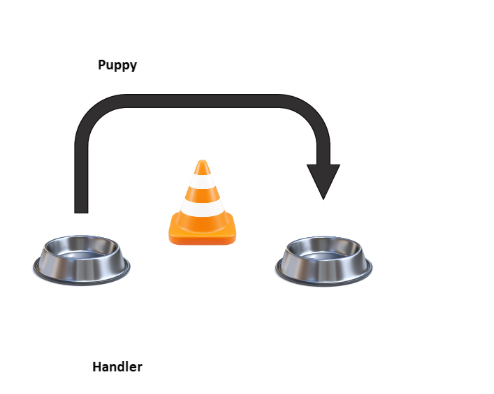
The pup learns to move around a cone or similar object to reach a food reward placed in a bowl. Over time, the pup begins to offer the movement independently rather than waiting to be shown what to do.
This game encourages the pup to notice patterns, solve a simple problem, and keep trying. Once the pup understands the game, it can also be adapted to introduce new objects, surfaces, and movement challenges in a safe and structured way.
Getting started.
You will need:
- Two metal food bowls. The sound of kibble landing in the bowl can help the pup notice where reinforcement is available.
- A cone or similar object.
- Kibble or another appropriate food reward.
Place the two bowls with the cone between them and have the pup start on the opposite side facing you. Begin by dropping a few pieces of kibble into one bowl, then the other, so the pup learns to move between them. As the pup becomes confident, wait a moment longer before dropping the food so they begin to offer the movement on their own.
Start by dropping a few pieces of kibble into one of the bowls. Let the pup eat the kibble before dropping a few pieces into the other bowl. The pup should hear the kibble hit the bowl and run towards it to eat. Continue dropping food into alternate bowls until the pup starts to predict where the food will be next and starts going toward the next bowl before the food is dropped. Start dropping the kibble only once the pup has gone to the other bowl, mark with “yes” and reward by dropping the kibble into the bowl.
Progressing the game.
Once the pup is confidently moving between the bowls, gradually move the cone further away from you so the pup needs to travel around it to reach the next bowl. Make very small changes and only progress when the pup is succeeding easily.
Troubleshooting.
If the pup stops solving the puzzle, becomes stuck, or starts making repeated mistakes, make the setup easier again. In a LIMA approach, we do not want the pup to become overwhelmed or rehearsed in frustration. Go back a step, help them succeed, and then rebuild gradually.
.png?w=420&h=335&auto=format&q=90)
Adding a challenge.
Once the pup understands the pattern, you can add one new challenge at a time, such as a different surface, a low pole, or another simple object to move around. Only change one part of the exercise at a time and return to an easier setup if the pup loses confidence or fluency.

Shake it off! Decompression walks.
What is a decompression walk?
A decompression walk is a relaxed stroll that allows pups to explore their environment at their own pace. This practice significantly enhances a dog's mental, physical, and emotional health, especially for those feeling fearful or frustrated.
Benefits of decompression walks.
- Mental stimulation : Sniffing and exploring engage a pup's brain, reducing anxiety and stress.
- Physical exercise : Helps maintain fitness, cardiovascular health, and healthy joints.
- Behavioural improvement : Reduces reactivity and fear, leading to a more well-adjusted dog.
- Training enhancement : A relaxed pup is more receptive to training and cues.
How to conduct a decompression walk.
- Use proper equipment : A longer leash and a correctly fitted collar.
- Choose the right environment : Choose quiet, safe areas with diverse smells and textures, such as parks, sports fields, beaches or hiking trails.
- Allow freedom of movement : Let the pup sniff, explore, and set their own pace without asking for obedience or skills.
- Frequency and duration : This will depend on the pup’s age, health and energy level. A Guide Dog pup will also be experiencing lots of socialisation opportunities, training sessions, leash walks where more discipline is required, and other mentally stimulating experiences.
You may integrate a decompression walk into your pup’s routine by taking them for a decompression walk two to three times per week, for around an hour at a time, or shorter for younger pups who are less than months old.
Risks and considerations.
- Overstimulation: Avoid environments that may make the dog anxious or excited.
- Supervision: Always keep an eye on the dog to ensure safety.
- Balance: Decompression walks complement, but do not replace, regular walks that teach leash skills, obedience and impulse control.
Decompression walks provide a vital outlet for dogs to engage in natural behaviours, helping them relax and adjust better to their human world.
Building confidence on public transport.
What does confidence on public transport look like?
When approaching, boarding, riding on and disembarking public transport, the pup displays confident body language, for example a loose, relaxed wagging tail, soft ears and facial features, moves towards and explores the environment, and recovers rapidly following sudden noises and movement.
Why do we build confidence on public transport?
It is important that the Guide Dog pup is confident with the approach and environment of public transport to learn specific guiding behaviours in these contexts and to confidently guide a future Handler on all forms of public transport.
How do we build confidence on public transport?
- The introduction of public transport will be done under the supervision of a PDA.
- Begin with a stationary form of transport, for example a bus depot or the end of a train line.
- Approach slowly. Give the pup time to explore and retreat if needed.
- Observe the pup’s body language. Move on when the pup appears comfortable.
- Use lots of pats, praise and food rewards to reinforce the pup moving towards and boarding the transport.
- Consider what is appropriate for the age of pup. For example, some smaller pups may require a lift onto the bus.
- Once on the transport, allow the pup to explore. Provide support and encouragement.
- Practice disembarking using the same gentle support, encouragement and use of positive reinforcement.
- Seating: board the transport again. This time, when the pup appears comfortable, take a seat and move the pup into the close position, or in a position where the pup can sit or lay down safely.
Riding public transport:
- When the pup is comfortable boarding, seating and disembarking, introduce a short trip. Options include a controlled environment such as a bus depot with a driver or going one or two stops on the train.
- Movement will introduce new sights, noises and sensations to the pup. Provide lots of encouragement, pats and praise as well as food rewards or a well-loved toy to help make the experience as positive as possible.
- Recovery: Observe the pup during and after the transport ride. It is not unusual for the pup to display some subtle signs of anxiety e.g. licking lips, yawning or shaking off. The goal is for the pup to stay within the green or yellow learning zone, and some repetition will help the pup to acclimatise and become more confident.
- If the pup is in the red zone, that is, demonstrating significant signs of stress like shutting down, tucked tail, shaking, or low posture, end the session and consult with your PDA who will help implement a training plan. This will usually look like returning to a stationary form of transport and using high value reinforcement to help counter-condition the pup to forms of transport.
- Pups in Puppy Raising do not have public access rights. Travel on public transport should be done as part of a class session or under the supervision of a PDA. If you require travel on public transport (such as to get to and from work), please speak to your PDA for approval. This will be treated on a case-by-case basis and depend on factors such as handler skill, pup suitability and whether other options are available. Nevertheless, travel on public transport will be at the discretion of Transport for NSW staff. If staff deny access or ask a Puppy Raiser to leave the bus, train or ferry the Puppy Raiser should follow their directions immediately.
