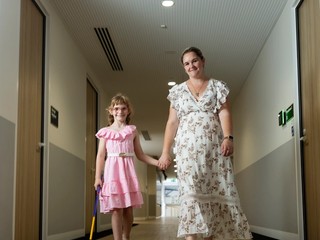
For Zara and Charlie, white canes mean freedom.
From alpine skiing and professional sports to moving to the city for the first time, moving through the world is a challenging, rewarding experience. And for people with blindness and low vision, there is a simple tool that can enable the freedom to navigate, one that is often underestimated: a white cane.
October 15 is International White Cane Day. The white cane, also called a long cane, is a mobility aid that can increase independence. It is a deceptively simple tool that can have an incredible impact on people’s lives, and it can be used by anyone, from young children to adults navigating complex, unfamiliar environments.
Zara Perry and Charlie McConnell both use white canes as part of daily life.
“I got my first cane when I was about three,” Zara says. She has oculocutaneous albinism, a condition which means she is legally blind and sensitive to light. Now, at 20 years old, using a white cane is second nature to her.
Zara’s white cane comes in handy for her when she is travelling in less familiar environments. She is an athlete who is on the Australian women’s team for goalball and competes nationally in alpine skiing, so she travels often. The versatility of a white cane suits her lifestyle.
“I'm heading to Melbourne tonight to go and visit a friend and then go to a sports camp. And I will 100% always use my cane when I'm in the airport because it’s an unfamiliar, shifting environment.
“But it’s also really good from a public visibility point of view, because a cane is a universal symbol of low vision. When people think of blindness, that's usually one of the first icons that comes to mind. And while there can be a lot of stereotyping around that, I think it can also be really valuable in spaces like an airport where I might need a bit of extra support.”

Because white canes are a recognisable symbol of blindness or low vision, starting to use one can be a journey of acceptance. This was the case for Charlie, who is now in his 60s and was first introduced to the idea of using a white cane when he was a teenager.
Charlie remembers, “Someone approached me about using a white cane at school. I was 15 or 16 at this stage. I, of course, rebutted that strongly. There was no way I was going to be different to anyone else and so using a cane wasn't going to happen. But the person was very insistent.” With the benefit of hindsight, it is a skill that he is so glad he learned, and he is grateful to the person who taught him.
Although Charlie avoided using a white cane when he was younger, as he reached adulthood he lost more vision, and found he was getting lost or injured more often. He also made the decision to move from his small regional town to Sydney, which meant learning to navigate areas that were much more crowded and had different hazards. As a fiercely independent person, losing the ability to explore and go places on his own terms was not an option, so he picked up the white cane and gave it another chance.

What he discovered was that the cane helped him to move independently in new and unfamiliar areas. He also found that for him, looking different to other people while using a cane was not a hindrance. It was a benefit.
“I found it much easier to use a cane and my whole world changed. People were more willing to help. They were less aggressive when I hit them, bumped them, knocked them over, whatever it might be. It was a great move,” he says.
As a self-described “sporty, outdoors person,” the freedom the white cane affords is perfect for Charlie. Because it is a light, portable tool that is easy to transport, and can be adapted to use in any environment, he can travel through the city.
Charlie notes that the cane helps with “judging or assessing risk, and then allowing me to safely negotiate, maybe with a bit of help. But nine times out of ten I’m able to safely negotiate any type of situation.”
For both Zara and Charlie, the white cane is a symbol of low vision, but also a symbol of freedom, and the way they move through the world.
Reflecting on her experience of having low vision, Zara says she encourages other people with blindness or low vision to find the tools that give this freedom to them. “Don't feel like you have to fit into the narrative that people are telling you a blind person should be. Create that narrative for yourself in terms of what actually works for you.” For her, and Charlie, that is a white cane.
Find out about Orientation and Mobility Services.
What is Orientation and Mobility?
A set of concepts, skills and techniques that teaches adults or children with low vision or blindness how to move around their environment safely.
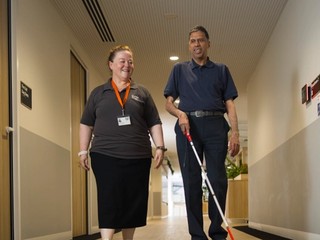
Orientation and Mobility for adults
Our Orientation and Mobility Service for adults can support you with everyday movement.
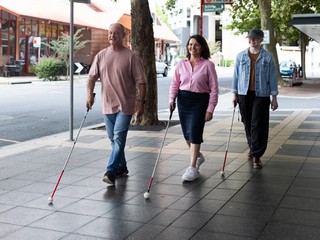
Orientation and Mobility for children
Orientation and mobility services for children and how to apply.