International White Cane Day 2026: Meet Cody
As a cybersecurity expert, Cody is no stranger to complex technology, but one tool that aids him in daily life is very simple: a white cane.
Cody has been blind since 2011, after he had surgery and treatment for brain tumours. This change meant that he needed to learn new ways of doing things that had previously come easily to him, like travelling and working. He has worked with Guide Dogs’ Orientation and Mobility Services to regain this independence.
Cody had received a white cane previously, but before he worked with Guide Dogs, he avoided using it.
“They actually give examples of what has happened or the best way to go about doing something: what works and what doesn’t work,” he says.
Because Cody works with technology every day, he found accessibility software relatively simple to adjust to, and gained a lot of benefits. However, for him, walking through the street
“I had some apps on my phone that I was using for GPS that I was addicted to, probably.” He remembers. “All I was focused on was what the GPS was telling me.
“My Orientation and Mobility Specialists taught me that the GPS technology is not good enough for someone to independently walk safely from A to B.”
Learning orientation and mobility is more than just finding technology that can assist. It is finding the best way to use that technology, so that it is truly an aid rather than a crutch. For Cody, this shift in mentality was key to switching from using GPS technology to a white cane, and ultimately having the freedom and confidence to walk outside again.
“GPS is something that can assist you about where you are, but not with using the contextual or environmental signals around you,” he says.
"My white cane is the best and only tool I have to detect vertical surface changes such as stairs, gutters and damaged walkways. It's a vital safety tool that GPS and similar digital technologies can't match.”
“My cane is also the only way I can use the tactical navigation markers built into footpaths that tell me where to turn to access areas such as road crossings and bus stops etc. It's really helpful in those situations.”
He worked with his Orientation and Mobility Specialist on learning to use sensory cues to navigate his environment.
“Because I work in IT, I thought technology was everything, and the rest was ancillary, but I learned over time that it’s quite the opposite. Those initial, immediate sounds, what you can feel with your cane about whether you’re going uphill or downhill and the surface you’re walking on gives you a much better picture of where you are in space.”
Using a cane means that he can rely on himself to interpret the world, wherever he is. The cane can also identify hazards in real time, like cars parked on the footpath.
“You can’t buy that kind of experience the Orientation and Mobility Trainers have collected over time. That’s been really invaluable to where I’m up to today,” he says.
“My cane is also the only way I can use the tactical navigation markers built in to footpaths that tell me where to turn to access areas such as road crossings and bus stops etc. Its really helpful in those situations.”
Finding a way to use mobility aids, like a white cane, as well as accessibility technology that works for him has been instrumental to Cody as he has adapted to blindness. For him, these tools augment his experience, and allow him to move through the world on his own terms.
Read more about our Orientation and Mobility Services.
What is Orientation and Mobility?
A set of concepts, skills and techniques that teaches adults or children with low vision or blindness how to move around their environment safely.
Orientation and Mobility for adults
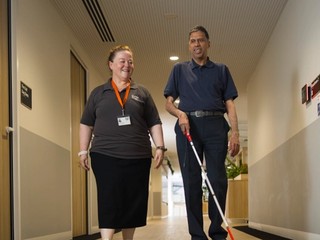
Our Orientation and Mobility Service for adults can support you with everyday movement.
Orientation and Mobility for children
Orientation and mobility services for children and how to apply.