On this page:
A history of Guide Dogs.
Leading the way for over 65 years.
Welcome to the first edition of the Guide Dogs magazine. We are proud to highlight the many ways Guide Dogs NSW/ACT is championing the rights of people with low vision or blindness throughout these pages.
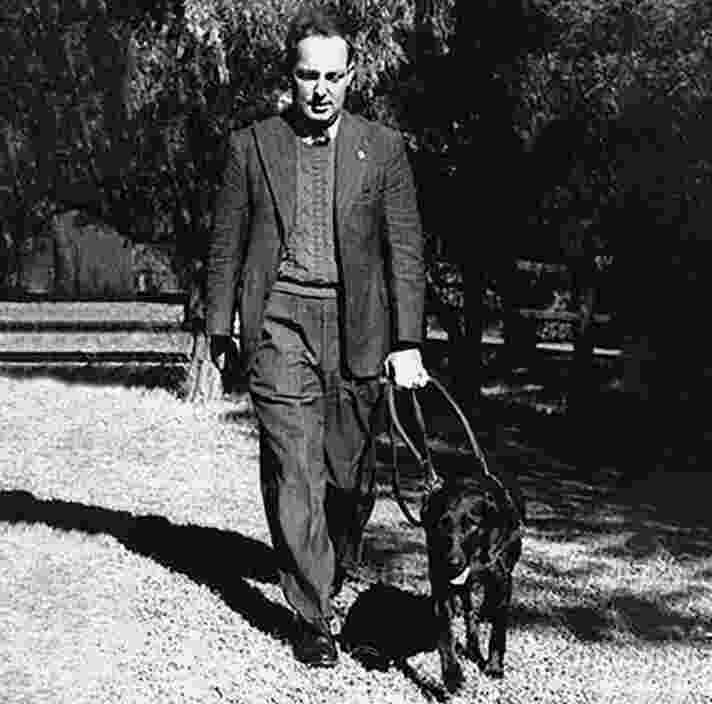
The Guide Dogs story begins in 1950, when Dr Arnold Cook arrived in Australia with the country’s first Guide Dog. Arnold lost his sight at 18 years old and became familiar with Guide Dogs after travelling to England to study. While he was overseas, he trained at Britain’s Guide Dog Association and was matched with his first Guide Dog, Dreena.
When Arnold returned to Australia with Dreena, other Australians with low vision or blindness were eager to partner with a Guide Dog. One year later, the first Guide Dog Association was formed in Perth and by 1975, there were Guide Dog Associations in each state and territory.
Fast forward to today, we’ve had some amazing achievements. We’ve expanded our projects to help people with low vision or blindness to create and achieve their goals. Some of the ways we do this include raising, training and matching Guide Dogs and Therapy Dogs with their Handlers. We also work with Clients to develop their skills through our Orientation and Mobility and Assistive Technology Services, and continue to support regional and remote Clients throughout NSW and the ACT.
However, the best is yet to come! In 2027, Guide Dogs NSW/ACT will be celebrating 70 years of creating opportunities and championing the rights of people with low vision or blindness. We’re excited about what the future holds.
Caring for your dog.
Expert training tips with Dr. Katrina Warren.
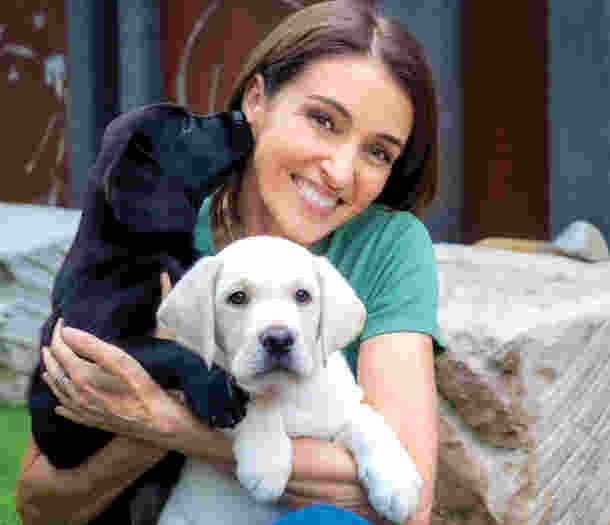
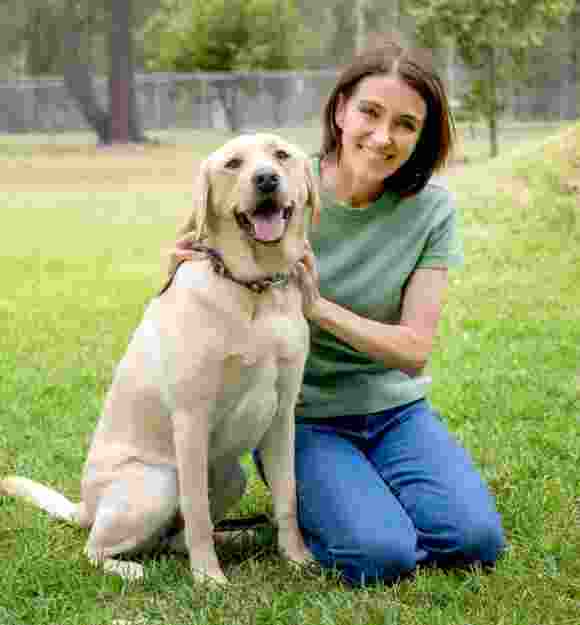
Dr. Katrina Warren, Veterinarian and Ambassador for Guide Dogs NSW/ACT has spent over 30 years working in the pet industry, sharing expert advice on television and social media platforms.
Below are our top five paw-sitive reinforcement training tips for your dog, in collaboration with Dr. Katrina.
Tip one: Instead of punishing mistakes, focus on encouraging success. This method strengthens your training outcomes and nurtures your dog’s trust, self-confidence and self-control.
Tip two: Connect with a local trainer if you’re dealing with a challenging behaviour. The best starting point is to connect with a local trainer who uses positive reinforcement techniques. They’ll assess your dog’s needs and create a personalised training plan for you and your dog.
Tip three: Use high-value motivators. When you introduce your dog to a new skill, new destination or new objective, build enough motivation for your dog to continue performing the task they’re learning. In the early stages of their training, provide a food reward every time they get it right, to motivate them to keep going. Using a reinforcer every time your dog performs the skill correctly is called continuous reinforcement and is important for the skill acquisition phase.
Tip four: Transition away from using motivators. Once your dog has really learnt the behaviour (we mean, your dog demonstrates the behaviour reliably and fluently), then you can transition to providing a food reward every second time, then every third time, and then randomly. This intermittent schedule of reinforcement is what we use to maintain motivation and accuracy without providing a food reward every time. You’ll use your other reinforcers (for example, pats or praise) on the occasions you don’t use food.
Tip five: Create the perfect training mindset for your dog. Create the perfect training mindset for your dog by ensuring they’re calm, have exercised and are ready to focus. Keep your sessions short, fun and filled with rewards to make learning a positive experience.
Taking care of your dog not only benefits them, but you too! According to a 2019 study by Springer Nature, dog owners are 31 percent more likely to meet physical activity thresholds and have better mental health. So, what are you waiting for? Take your dog for a walk or run outside and try out some positive reinforcement techniques!
"I’ve watched hundreds of people welcome a puppy, and nothing gives me more pleasure than helping new puppy owners build a strong bond with their pup while raising a social and well-mannered dog."
Dr Katrina’s passion for pets.
At Guide Dogs NSW/ACT, we share Dr. Katrina’s passion for pets, and understand the importance of taking care of not only our working dogs, but our pet dogs as well. Since starring on the show ‘Harry’s Practice’, Dr. Katrina has become a pet care influencer, sharing her expert tips and knowledge on social media. She loves to give advice on how you can ensure your dog is healthy and happy, as well as training and canine exercise tips.
When training your puppy to learn new commands and behaviours, Dr. Katrina takes a calm and pragmatic approach. “If I could give you one piece of advice, it would be this: Always set your puppy up to win. Prevent them from getting into situations where they may have an unpleasant experience or learn bad habits. The focus should always be on building their confidence and managing them properly when you can’t actively supervise them,” she says. Positive reinforcement is one of the ways our expert Guide Dog Trainers train our dogs.
Dr. Katrina has partnered with us to provide you with free training, nutrition and exercise tips for your pup, through The Learning Lab program.
If you would like to sign up to receive these tips, along with advice from our expert Guide Dog Trainers, sign up for The Learning Lab.
Karlee and Isla: the perfect match.
The life-changing impact of receiving a Guide Dog.
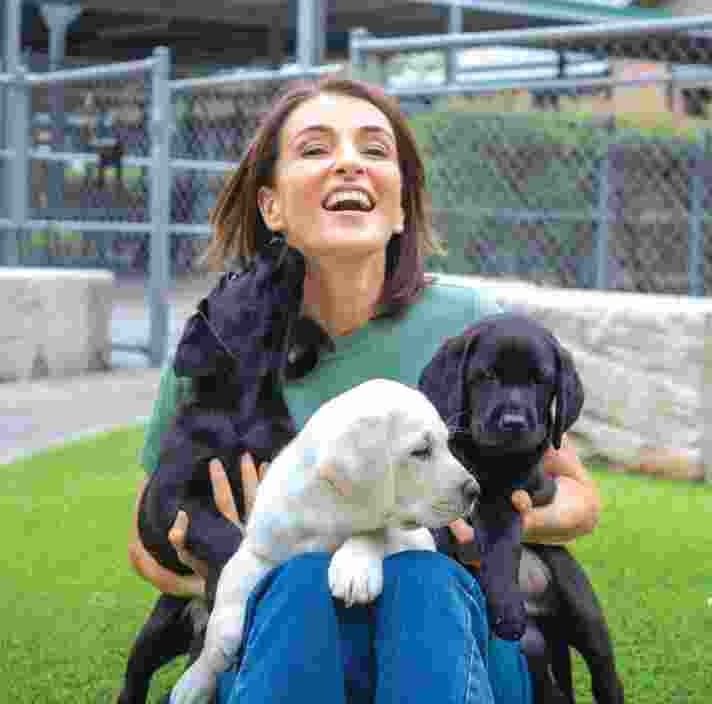
Karlee was matched with Guide Dog, Isla, in July 2023. She was Karlee’s second Guide Dog after her first dog had to retire early. Karlee dreamt of having a Guide Dog since she was six, and when she finished school and started university, she was finally able to turn that dream into a reality.
It took time for Karlee to become the person she is today. Growing up, she was a shy, quiet kid. When she began attending Guide Dogs NSW/ACT programs and camps, she made friends, bonded over shared experiences, and felt less alone. But before having a Guide Dog, she was still anxious about going out and navigating her community with a cane. The night before she needed to go somewhere, she often couldn’t sleep, worried she might run into something.
But once she was matched with Guide Dog, Isla, Karlee started doing things she never dreamt of, like moving from Nowra to Sydney.
While Isla is in harness, she’s the ultimate professional. Off duty, it’s a different story. “When she’s off harness, she is such a crazy girl. Honestly, she has so much energy; I can’t even express how much energy this girl has. She really loves her squeaky toys, and she’s such an affectionate dog. She’s always wanting to lick me, lean against me, and is so cuddly.”
Isla will happily go wherever Karlee goes, including work, the gym, university and travelling on holiday. At the gym, the staff adore having her around and let her lay behind the counter while Karlee works out. Though, Isla would prefer to participate over supervise.
Luckily, Karlee is often out and about catching up with friends, which Isla loves. “Guide Dogs NSW/ACT couldn’t have done a more perfect job of matching our personalities because Isla’s exactly the same as me in dog form. She’s very social and loves being around people and other dogs, just like I do,” Karlee says.
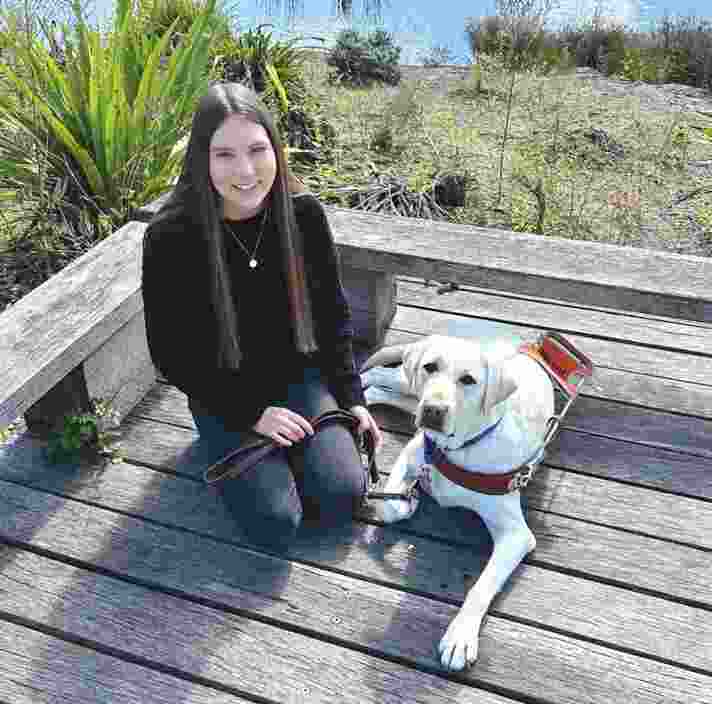
"I’m in awe of Isla every single day because of what she does, how much she helps me, and how she’s changed my life. I’ve grown so much as a person from having Isla by my side. We’ve been able to really live life and find new opportunities. I’ve never loved anything more than Isla."
A message from our CEO.
Hear about Guide Dogs NSW/ACT.
Many of you know us for our life-changing Guide Dogs, who provide independence and companionship for people with low vision or blindness. However, we also offer a wide range of services and Client programs that support people with low vision or blindness of all ages to increase their independence, gain confidence and live the life they choose.
This year, we’ve increased our advocacy efforts to break barriers, raise awareness, and connect with the community to advocate for positive change. This has led to some great initiatives, including efforts to improve accessibility in the hospitality industry and the growth of our Inclusion Ally community.
I am also proud to note that Guide Dogs was awarded ‘Highly Commended in the Charity Brand category for the 2025 Reader’s Digest Annual Trusted Brand Awards, once again recognising us as one of Australia’s most trusted charity brands.
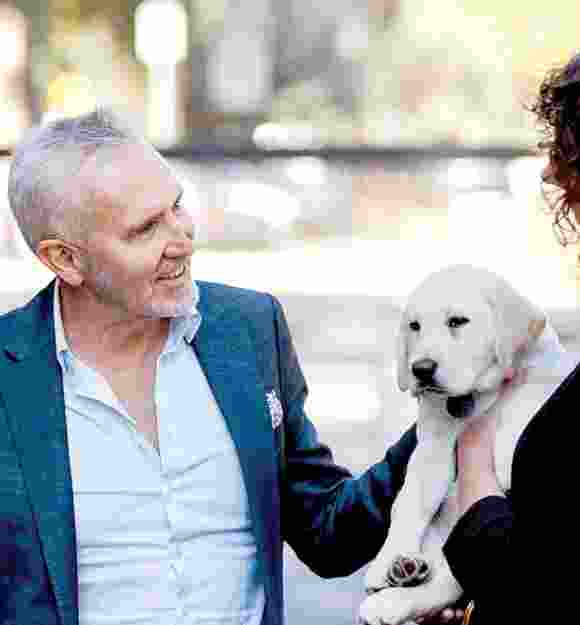
In May 2025, we launched SeeWay, a fabulous new initiative for individuals with moderate low vision who may not qualify for funding but urgently need support to manage everyday life independently. SeeWay is aimed at individuals who may fall between the gaps in existing programs, and it focuses on providing practical and emotional support to help them navigate their low vision journey.
In 2027, we will be celebrating 70 years of Guide Dogs! We couldn’t achieve all our vital work without the support of our incredible donors, volunteers, and Inclusion Allies. Your generosity is crucial to enable us to empower people with low vision or blindness to navigate their communities safely and independently.
I am so proud to lead this organisation during such an exciting time, and share the stories of our Clients, staff, volunteers, and supporters with you.
Warmest regards,
Dale Cleaver
Chief Executive Officer
Guide Dogs NSW/ACT
Assistive Technology for people with low vision or blindness.
Including recommendations and advice.
At Guide Dogs NSW/ACT, we’re more than dogs. Another vital support we offer is our Assistive Technology Service. Assistive Technology empowers people with low vision or blindness to live independently, stay connected, and access the world around them.
It includes any tool, device, or software designed to support everyday tasks and goals, including reading the newspaper, accessing your phone, and doing the shopping. Technology can also assist with navigating your community, as GPS apps can tell you what’s around and help you get where you need to go.
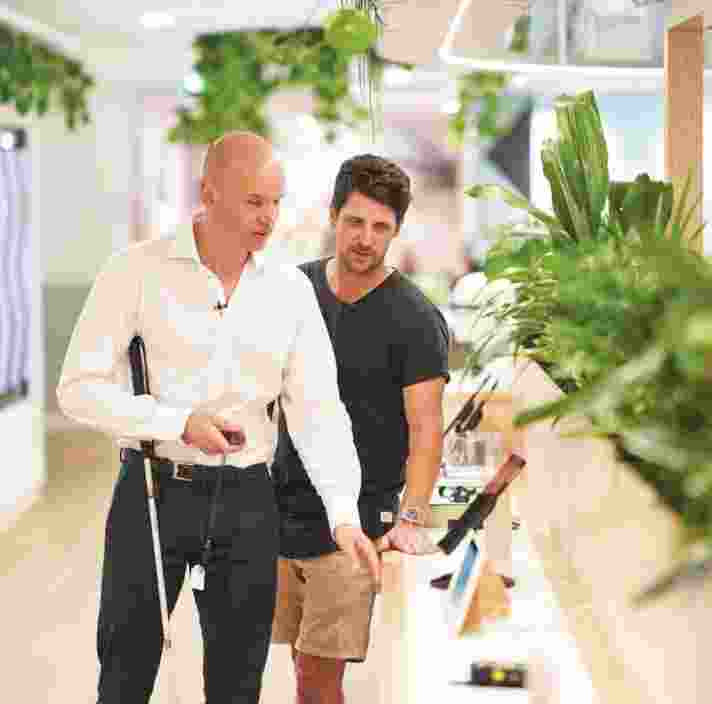
Emerging Technology and Accessibility Manager, Ben Moxey, is responsible for enhancing the accessibility of Guide Dogs NSW/ACT and its services. “After all, it doesn’t matter if someone who is blind can use a computer if the content they want to access with their screen reader doesn’t work,” Ben says. “I also keep tabs on technological innovations that might be useful for people with low vision or blindness so we can influence design and perhaps use the products in service delivery.”
Testing Assistive Technology is a big part of Ben’s job. Being totally blind, Ben knew that mastering Assistive Technology would be key to his independence because he needs to be able to use computers like everyone else. He now also helps other people with low vision or blindness do the same by providing support, reviews, and resources for Clients and Guide Dogs NSW/ACT staff. “Assisting someone else with their independence is the best part of my role,” he said.
Some of Ben’s recommendations include:
- Screen readers, like JAWS or NVDA, which convert on-screen text into speech.
- Screen magnifiers, such as ZoomText, which enlarge and enhance screen content.
- Smartphones with built-in features like magnifiers, text-to-speech, and voice assistants.
- Braille displays and notetakers, which allow people to read and write using Braille.
Learn more about our Assistive Technology Services and Assistive Technology Help Desk, or call 1800 484 333.
Our Therapy Dogs.
Hear more about our life-changing dogs.
Did you know, we don’t just raise and train Guide Dogs to assist people with low vision or blindness to navigate their communities safely and independently? We provide Therapy Dogs for individuals and facilities too!
The primary role of a Therapy Dog is to provide companionship and emotional support to individuals in and around their homes and communities. On a broader scale, Therapy Dogs can also be present in facilities like emergency and frontline services, healthcare clinics, schools, aged care facilities and nursing homes, courts and tribunals, psychology and counselling practices and rehabilitation clinics.
We offer Therapy Dogs for three different types of facilities:
Wellbeing Dogs.
Wellbeing Dogs provide emotional support to frontline workers in high stress environments like emergency services, healthcare clinics and psychology practices. These dogs can also provide comfort to people living in aged care facilities and nursing homes.
School Support Dogs.
School Support Dogs enhance the wellbeing and emotional stability of students and teachers learning environments.
Court Dogs.
Court Dogs provide comfort and emotional support to court staff and individuals in settings like court rooms, remote witness rooms, jury selection and interview rooms.
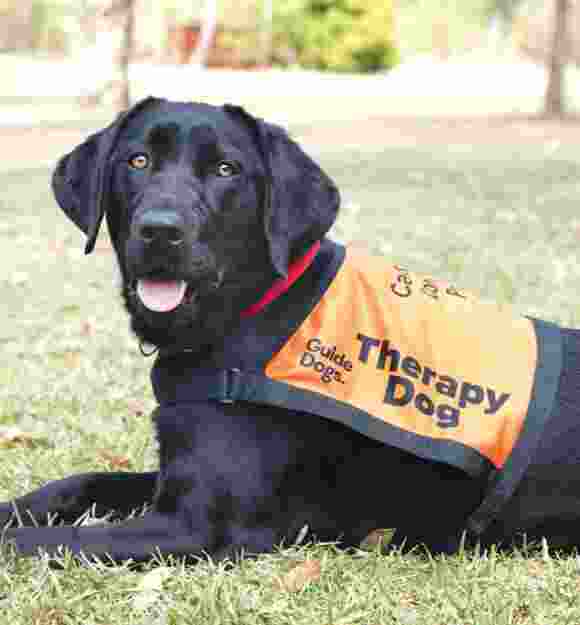
Meet John and Therapy Dog, Harper.
“I am an elderly, married man in good health. I have low vision as a result of Glaucoma, but my vision is sufficiently adequate that I have not required the services of a Guide Dog.
However, in 2019, I became the lucky recipient of a Therapy Dog, named Harper. Living on a farm, I have always been around working dogs and companion dogs, but never did I expect to feel the overwhelming companionship and love I received from Harper, my Therapy Dog. She is so intuitive of my feelings and seems to know when I need the presence of her company before I even do.
She gives me a reason and stimulus to get out of bed in the morning. I enjoy the responsibility and purpose it gives me to get up and feed her and take her for a walk.”
– John, Harper’s Handler.
To learn more about our Therapy Dog Program for individuals and facilities and to express your interest, call our Therapy Dogs team on 1800 436 364.
Donation Dogs: make change matter.
How your business can host one of these iconic community pillars.
Do you recognise our iconic Donation Dogs? Maybe you’ve dropped a coin in a dog at your local supermarket, or watched a child give a dog a big hug.
Behind these nostalgic Donation Dogs that have been present in over 1,000 locations across NSW and the ACT for over 50 years, is our mission to help people with low vision or blindness live the life they choose.
Why host a Donation Dog?
- It’s free, easy and makes a real impact on our community.
- All Donation Dogs are safe, lockable and easily secured to counters or stands. We take care of maintenance and emptying, so there’s no extra work for you.
- Your Donation Dog shows that your business supports a great cause and helps fund vital services for people with low vision or blindness.
The only thing left to do is name your dog!
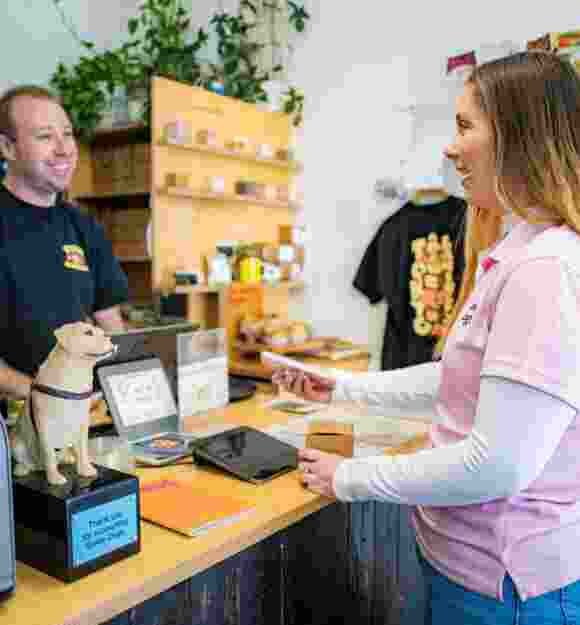
Here are some of the services that your Donation Dog can fund:
- Orientation and Mobility Services: everyday travel skills to keep adults and children with low vision or blindness moving with confidence!
- Guide Dog Mobility: supporting people with low vision or blindness to partner with a Guide Dog to access the community.
- Occupational Therapy: practical skills for everyday living, regardless of age or level of functional vision.
- Assistive Technology Service: supporting people with low vision or blindness to use hearing and touch to continue accessing print and electronic information from the world around them.
Ready to adopt a Donation Dog?
Visit the link below to fill in our application form or call us on 1800 436 364 and select option one.
You can also email our team at
donationdog@guidedogs.com.au.
Lessons, Labradors and lots of love.
20 years of puppy raising.
Allysia never imagined that a simple question from a student would change her life. While working at a boarding school on Sydney’s North Shore in 2005, a student researching for a project about Guide Dogs NSW/ACT came across puppy raising and asked, “why can’t we do this here?”
Allysia’s school became the second in NSW to have a dog on campus, well before the therapeutic benefits of dogs in schools were widely recognised.
Now, 18 life-changing Labrador pups later, Allysia is Head of Boarding at Ascham School in Edgecliff, Sydney. She cares for 125 boarders, most of them being girls from regional NSW, and lives on campus with her husband and daughter. Puppy raising is not just a solo effort; it’s a family affair and a school-wide initiative. Although the pup lives with Allysia’s family and joins her on weekends and holidays, they’re first and foremost part of the school and boarding house community.
Being a Puppy Raiser for Guide Dogs NSW/ACT is a volunteer role that involves caring for a Guide Dog puppy in your home from eight weeks to around 14 months old. It’s all about giving the Labrador pup the best possible start in a loving home, socialising them in different environments, and helping them learn basic training.
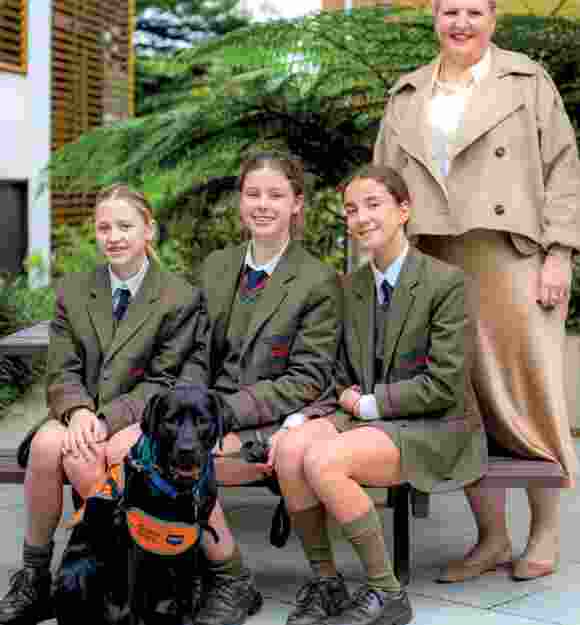
One of the things Allysia values the most about puppy raising is the ongoing support she receives from Guide Dogs NSW/ACT whenever she has a question or needs help with a puppy. “You get so much support from your Puppy Development Advisor, from the Guide Dogs team, and from the network that you create, which makes it easy to bring a dog into your home and love them,” she says.
For anyone considering volunteering to become a Puppy Raiser, Allysia says, “I would say, don’t hesitate. Get your family on board, whatever that looks like, and get others involved too, because it’s not a solo project. You will be supported through each step.”
Interested in volunteering to become a Puppy Raiser for Guide Dogs NSW/ACT? Visit our website to sign up as a Puppy Raiser.
"If all we have to do to help someone gain mobility and independence is to love a dog in this environment and expose them to lots of people, then that's a pretty easy thing for us to do, and an amazing experience for our boarders to be a part of."
Bridging the gap for support and services for people with low vision.
SeeWay: a Guide Dogs initiative.
Many Australians are currently adjusting to a life with low vision, and many people who experience changes in their vision aren’t eligible for government-funded services. They’re left without the support and tools they need to navigate life with these vision changes. SeeWay is an initiative of Guide Dogs. It is a free, national service focused on supporting people with moderate low vision.
What is low vision?
Low vision is not blindness, it’s reduced sight that cannot be corrected with glasses, contact lenses or surgery. People with low vision may permanently experience:
- blurred or hazy vision;
- loss of central or peripheral vision;
- poor night vision or light sensitivity; or
- difficulty with contrast or depth perception.
SeeWay assists Clients to meet their personal goals, including enhancing digital literacy skills, emotional coping mechanisms, and staying connected with friends and family. Tailored information and pathways based on these needs are provided, and when additional support is needed, Clients are referred to trusted national and local services.
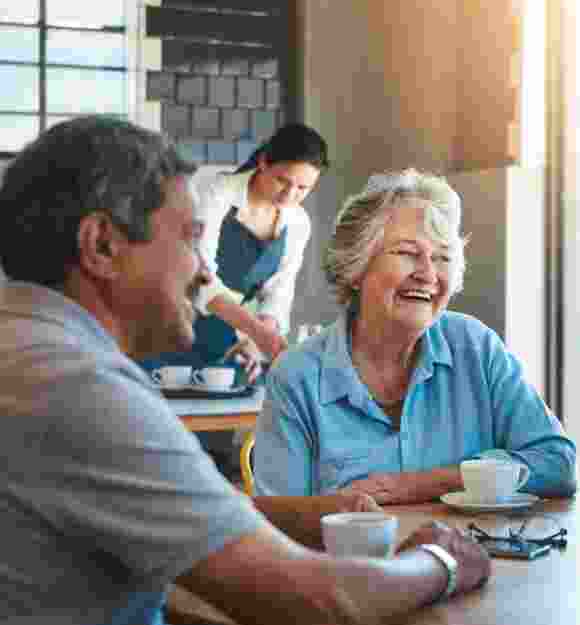
SeeWay offers a range of services, including:
- Personalised digital literacy training through one-on-one support to assist people to use their digital devices while navigating changes in their vision.
- Empowering information and resources that offer practical, positive guidance to help people take control of their lives, instead of fearing their diagnosis.
- Guidance to other appropriate support services around the country, so Clients never feel alone on their journey.
To learn more about how you or a family member can benefit from the services of SeeWay, visit the link below. Alternatively, call 02 8350 1400 or email info@seeway.com.au.
How a legacy changed Abby’s life.
The impact of leaving a gift in your Will.
With Duke by my side I have confidence, a sense of safety, stress free travel, invaluable companionship and, sometimes, a good laugh. I could not be without him in my life.” – Abby, Guide Dogs Client.
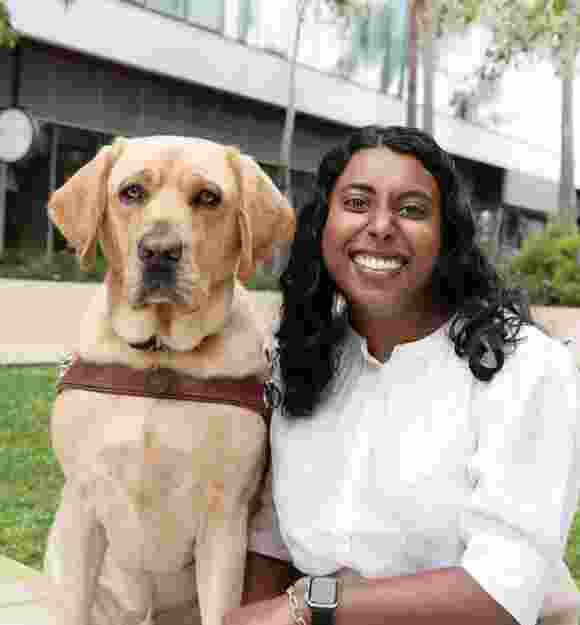
There are over 500,000 people in Australia living with low vision or blindness, and that number is growing every year. As gifts in Wills fund more than half of our dogs and services, they have an incredible impact on the lives of people with low vision or blindness. Guide Dogs NSW/ACT Client and Assistive Technology Specialist, Abby understands more than most about the life-changing impact that gifts in Wills have.
“Guide Dogs has supported me over the years by building my capacity to travel independently, starting out by learning and mastering cane skills, progressing to GPS navigation, and using travel apps for public transport. Guide Dogs also introduced me to the VoiceOver accessibility feature on my iPhone, which prompted me to explore other digital accessibility features, and led to my career as an Assistive Technology Specialist,” says Abby.
In addition to receiving these vital services, Abby was matched with her Guide Dog, Duke. “Receiving a Guide Dog meant I could walk faster and have confidence knowing there’s two heads working on the problem if I get lost.”
With Abby and Duke’s match, came a renewed sense of confidence, security and safety, as he’s helped her to regain her independence to live the life she chooses.
Did you know, if you have included a gift of $50,000 or more in your Will to Guide Dogs NSW/ACT, you can request to name a puppy in your memory?
Their first walk went without a hitch, and “it was love at first sight.” By the time Duke came to live with Abby, he was glued to her side and was nicknamed “The Leech” because he never wanted to be separated from her. At three years old, Duke is now an expert at weaving through suburban crowds, shopping centres, up and down escalators and around busy train stations. When he isn’t working, he loves curling into a small ball to have a cat nap, just like the cats he was raised with as a puppy.
Clients like Abby can receive life-changing dogs thanks to the generosity of people who leave a gift in their Will. These dogs often carry on the namesake of the donor whose gift has enabled them to embark on their meaningful career to support and empower a person with low vision or blindness to live life their way.
If you would like to find out more about how to leave a gift in your Will to Guide Dogs NSW/ACT, please call our friendly team on 1800 940 579 or visit the website using the link below.
How we’re creating a community that everyone can access.
Breaking barriers through advocacy and education.
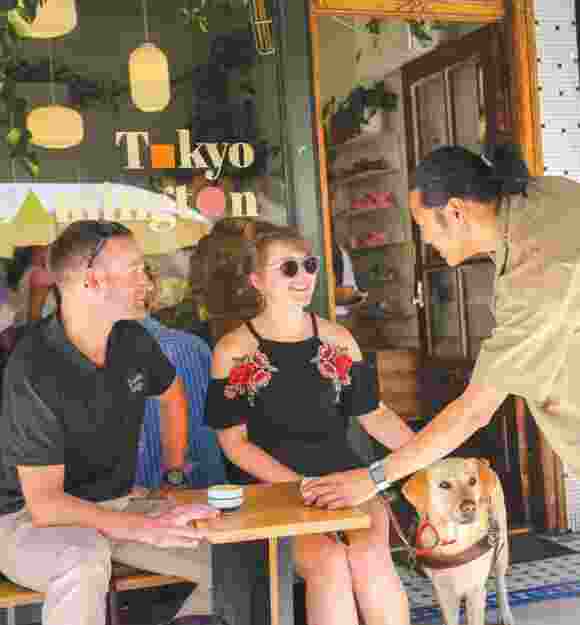
Driving change, one café at a time.
Dining out is more than enjoying a meal. It’s a way to connect, celebrate, and belong. However, our research shows that only one in three people with low vision or blindness feel confident accessing their community, including cafés and restaurants.
Despite years of advocacy and growing awareness, many hospitality businesses and staff still lack the tools and training to provide truly inclusive services.
Earlier this year, we ran the, “Access means business” campaign with the City of Sydney to educate the hospitality industry about the rights of Guide Dog Handlers to access all public areas, and how to make cafés and restaurants more accessible for people with low vision or blindness.
For Dan Searle, a Community Mobiliser with Guide Dogs NSW/ACT and a Guide Dog Handler, this campaign was personal.
Part of Dan’s regular routine is visiting his local cafe. As one of only a few Guide Dog Handlers in Albury, Dan is well-known and welcomed. “You tend to form a relationship with the business owners because they’re smaller businesses in a smaller community. So, I find they are inclusive and treat me with respect,” he says.
However, it’s not always easy for Guide Dog Handlers like Dan to visit cafés or restaurants. Unfortunately, some Handlers still encounter refusals and access issues, despite it being illegal.
“In my experience, most people want to do the right thing,” Dan says. “They want to be more accessible and inclusive. But they don’t always know what the right thing is, so it’s nice to offer them some practical tips.”
Dan explains that accessibility doesn’t have to involve costly renovations. Simple changes including training staff, understanding access laws, and providing accessible menus can make a big difference. We offer resources and training to help hospitality businesses become more inclusive and confident in welcoming all customers.
Join us to create a more inclusive society.
We’re looking for people like you to help spread the word and stand with us, as we work to reduce the barriers that prevent people with low vision or blindness from living the life they choose.
Dan says, “If people have specific skills, knowledge, or a particular area they want to advocate for, we’d love to hear from them. The more people who can sign up and help us spread the word, the better and easier it is to get our message across.”
Visit our website to sign up as an Inclusion Ally. You’ll receive updates on our advocacy campaigns and learn how you can volunteer your voice or your time to make a real difference. We can’t create positive change without your help!
Ready to continue?
Seems like you have filled this form earlier. Let’s pick up where you left off.